)
The Journey to Unearthing the Pain Points in Data Science Development

TL;DR
At Zerve, our mission is to elevate the impact of data science by removing the barriers that prevent data professionals from reaching their full potential.
Our mission at Zerve AI is crystal clear: to Elevate The Impact of Data Science. This mission was born out of the frustrations our team had in delivering data science projects at scale, and shaped by the community of “code first data users” we’ve spoken to along the way. The journey began with a commitment to understanding the daily challenges faced by Data Scientists, Data Engineers, and ML Engineers. After hundreds of hours of interviews, it became clear that this mission was much bigger than us, it was about empowering the entire data science community.
The Current Landscape
Our conversations revealed a sobering reality: the state of data science tools is limiting the potential of highly skilled professionals. Despite brilliant inputs, the outcomes were often stifled by inefficiencies in the tooling available today.
Voices from the Field
We didn’t just want numbers; we wanted real stories. Interviewees consistently laughed and nodded when shown this slide of pain points, because it reflected their daily struggles:
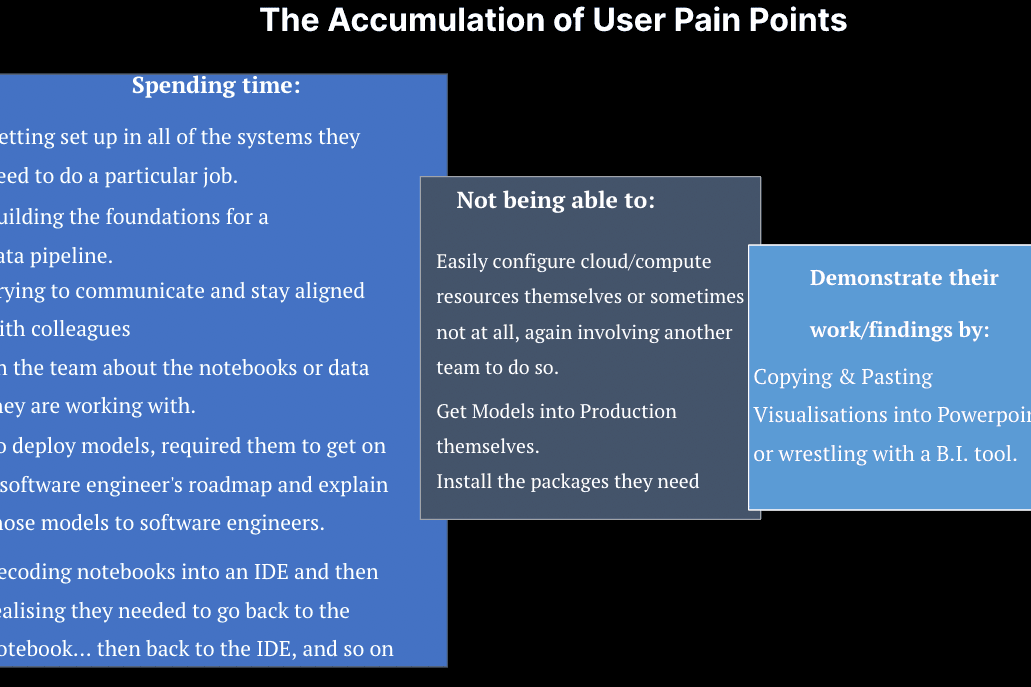
The Pain Points
Getting Set Up
Data scientists spend far too much time setting up environments, packages, and access. Stories ranged from “months into a job still SSH’ing into a server to run a notebook” to describing onboarding as “misery.”
Communication Challenges
Misalignment on notebooks, data order, or dependencies often created bottlenecks. Some teams even resorted to Slack emojis to track notebook statuses, an unsustainable way to collaborate.
Deployment Hurdles
Moving from prototype to production often meant awkward handovers to engineering teams, creating delays and frustrations across both disciplines.
Resource Configuration
Configuring compute and cloud resources frequently required tickets to other teams, putting data scientists out of control of their own work.
Demonstrating Work
Too often, results were reduced to screenshots pasted into slides. As one CDO remarked: “I thought I hired coders, but all I got was charts in a PPT.” Lack of data apps and integrations diminished impact across the organization.
Leaders' Perspectives
Executives echoed similar frustrations. Despite hiring top talent, they often felt little impact on business objectives. The gap wasn’t due to a lack of skill, but a lack of infrastructure and tools enabling data scientists to deliver at scale.
Enter Zerve
Read about how we launched Zerve in response to these widespread challenges.
FAQs
Common challenges include long setup times, poor collaboration on notebooks, difficulty deploying models, limited access to compute resources, and ineffective ways to demonstrate results.
Deployment often requires coordination with software engineers, creating bottlenecks. Without integrated workflows, projects stall at the handoff stage.
Most teams rely on notebooks that aren’t designed for multi-user workflows. This leads to communication issues, dependencies on individuals, and inefficiency when teammates are unavailable.
While data scientists produce valuable insights, without the right tools their work often fails to reach production or integrate into business processes. This creates a gap between talent and measurable outcomes.
Zerve was built to close the gap between exploration and production. It simplifies setup, enables collaboration, streamlines deployment, and provides the infrastructure needed to deliver data science projects at scale.