Mohamed Beydia of Canal+ on Scaling Data & ML in Production
November 07, 2024
At the Analytics Summit in Dublin, Mohamed Beydia, Head of Data & Analytics at Canal+, shares the inside story of Canal+’s data transformation journey, as leveraged the data from its streaming platform.
Hired to lead the transformation, Mohamed faced a classic CDO dilemma: Strengthen the data foundation for years before delivering value — or find a way to ship meaningful AI use cases fast. In this talk, he explains how Canal+:
Shifted from descriptive to predictive analytics maturity
Prioritized high-impact AI use cases using an impact vs. effort framework
Strengthened data foundations incrementally within each use case
Centralized on Snowflake + AWS while maintaining regulatory compliance
Deployed real production AI without expanding the data science team
He shares real-world examples, including:
A churn prediction model with explainable AI + generative scripts for retention teams
Real-time personalized engagement emails powered by LLMs
A hybrid semantic search engine with vectorization
Personalized streaming recommendations by household profile
Mohamed also shares how the team reduced the friction between experimentation and production, moving from local notebooks to fully deployed systems in months, not years.
If you're a Chief Data Officer, Head of AI, or data leader navigating the balance between governance and delivery, this session offers a practical blueprint for driving measurable impact fast.
0:03
My main mission here is to introduce
0:05
Muhammad. Uh so Muhammad Bedia is the
0:08
head of data and analytics at Canal Plus
0:11
and he's been doing some really
0:12
fantastic things with uh with Zerve in
0:15
his role and so let's give him a big
0:17
hand. Welcome.
0:23
Well, thank you. Um so I would like to
0:26
introduce you to our data transformation
0:28
journey. So exactly 18 months ago I was
0:31
hired by Canalas to start the data
0:33
transformation and uh this
0:36
transformation was motivated by the fact
0:38
that we used to be a satellite company
0:40
and we moved to internet and so we have
0:42
a lot of data points on customers and we
0:44
would like to move to more AI machine
0:46
learning and stuff like that because we
0:48
have realtime data now and and we have a
0:51
service offering like Netflix on video
0:53
video in demand and stuff like that and
0:54
also the fact that because of the AI
0:56
buzzword our sea level start hearing
0:59
about AI etc and you know as most of the
1:01
companies does this uh last two years
1:04
they wanted to tap into the potential of
1:06
AI so I was hired to to do this data
1:09
transformation but as as many of you
1:12
know garbage in garbage out this is the
1:14
fundamental concept in when you do data
1:16
analytics um I was in a kind of a
1:19
dilemma that most of the chief data
1:21
officer knows that either you spend time
1:24
strengthening your foundation putting in
1:26
place data governance putting data
1:28
engineering best practice and
1:31
strengthening your foundation to be able
1:32
to do accurate um uh data analytics and
1:35
AI and this will take you three four
1:38
years and without being able to deliver
1:40
you know fundamental and gamechanging um
1:43
uh product and stakeholders will lose
1:46
face on on on you and said so this is a
1:49
classic dilemma that um um chief data
1:51
officer are are facing so we decided to
1:54
have another approach um I will talk you
1:57
about this approach So to today we we we
2:01
moved from descriptive like the very
2:03
granular basic level of analytics
2:05
maturity data maturity to predictive and
2:08
by end of the year we will reach a
2:10
perspective and I will explain how we
2:12
reach that that level. So we decided
2:15
first to identify what kind of use case
2:17
we wanted to do with data what value we
2:19
want to create and so we focused on on
2:22
on these uh these pillars. So
2:24
acquisition we want to acquire more
2:26
customers, improve a customer
2:28
relationship, uh increase meant to
2:32
strengthen the relation uh retain
2:34
customers, develop content strategy, uh
2:36
cost-saving automation and do all of
2:39
this by uh being compliant with the eyes
2:41
of regulators. So we collected all of
2:43
these use cases to see what what are the
2:46
most important one of them and then we
2:48
put them into this impact versus effort
2:50
metrics. So to highlight to identify the
2:53
the the easy the quick wins and the
2:55
strategic project and then after we did
2:58
that we start we said okay we're not
3:01
going to uh strengthen the foundation in
3:03
one shot we will strengthen the
3:05
foundation within the data scope of this
3:08
each of these use case. So we've done
3:10
this basic uh basic data transformation
3:13
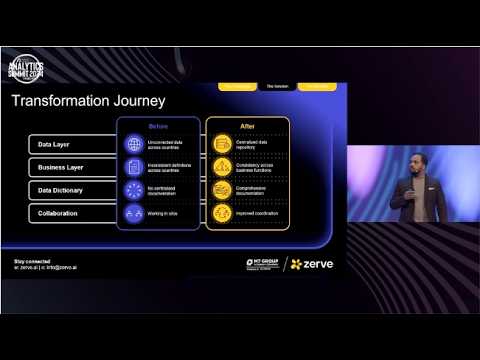
that you probably know. So we went from
3:16
a decentralized uh data space to um
3:20
snowflake and using AWS. So you really a
3:24
centralized repository we unified
3:27
business definitions and and put some
3:29
data dictionary and collaboration. And
3:31
this is did not take didn't take us too
3:33
much time because we were just focusing
3:35
on a very niche uh uh uh part part of
3:38
our our our data set. And then after we
3:41
did that, so now we're ready to tap into
3:43
machine learning and and generative AI
3:45
etc. within this scope again we wanted
3:48
to have a tool that will help us uh do
3:52
this because the data is ready. It's
3:54
clean. We have we document it very well
3:56
and I've I worked before in big fours in
3:59
the loit and PWC and I spent many years
4:01
in banking and I know that to put a data
4:04
science product into production it's
4:06
really really hard because building a PC
4:08
is one thing but going into production
4:10
you need to rely on it uh you need to
4:13
work with uh some you know sometimes
4:15
developers to put something in your
4:16
website etc. And I wanted to have a tool
4:19
that will allow me to put this uh use
4:22
case into production without this burden
4:24
because I am I'm not in the capacity to
4:26
go and talk to uh our board members and
4:29
tell them okay I need the I need to hire
4:31
X number of data scientists etc because
4:33
they have not seen value yet. So we need
4:36
to show some uh use cases some value
4:39
that then come back and ask for hiring
4:41
uh people. So this is where we relied on
4:45
Zerf. So I'm going to show you quick
4:46
some use case that we put quickly uh
4:49
thanks to to Zerf. So the first one was
4:52
um churn churn uh churn um churn
4:55
prediction model and this the
4:57
specificity of the churn prediction
4:59
model is that it's also
5:02
use explainable AI to understand why
5:04
customers are churning and then use
5:06
generative AI for our commercial team to
5:08
have a script and and talk to uh uh use
5:11
it by marketing to talk to our customers
5:13
to retain them. So we we follow these
5:15
five steps to understand why customer
5:18
are churning. Um we mathematically
5:20
modeled the churn phenomena. Uh we
5:23
selected a group of people to we would
5:26
like to act on and we build this. So all
5:28
of this has been built entirely inside
5:30
uh zer. So it is a a bunch of uh SQL and
5:34
and python with our uh codes and
5:36
everything was in zer. What I really
5:38
liked here is that with Zerve we we
5:41
connected directly to uh Snowflake which
5:43
is our data warehouse and you could see
5:45
engineers uh data scientists and IT
5:48
teams working into into the same uh
5:50
platform and this is this is quickly
5:53
some result of this model. So we it was
5:56
uh implemented into the Netherlands. So
5:58
I didn't mention that M7 span over nine
6:01
countries and Netherland being one of
6:03
one of the biggest market we have and so
6:05
we could see like a detection coverage
6:07
with this churn prediction model of 70%
6:10
uh when in the back testing phase and
6:12
when uh marketing team start testing it
6:14
we uh using different AB testing
6:17
approach we could see um uh uh good
6:20
results depends on the strategy of
6:22
communication you we did and this beta
6:24
testing approach was was used um uh was
6:27
was made thanks to generative AI.
6:31
So another topic which is I'm sure when
6:33
you watch something on Netflix on Prime
6:36
you you get instantly or the day after
6:39
an email showing you yeah hey you watch
6:41
this maybe you will look at look at this
6:44
and for us this is was like wow this is
6:47
very hard to to to use for the record
6:50
Netflix spent 12 years every year
6:52
spending 1 million on their
6:53
recommendation engine and we were like I
6:57
would say babies in the in in in the AI
6:59
world. So we wanted to have something
7:01
quickly. So we we builded this this
7:04
model inside uh inside Zerf using AWS
7:07
bedrock this this LLM. So everything was
7:10
compliant with our IT department and so
7:12
no red flags on it and these emails that
7:16
you see on the right side on the screen
7:17
has been generated automatically via API
7:20
calls within the observe environments
7:22
and it is running uh um real time. So
7:26
whenever someone watch uh and we have
7:29
like a buffer of couple of hours they
7:31
receive this these kind of emails and
7:34
the impact was could we we could see the
7:37
impact because as you can see here it's
7:39
just a sample of people that receive
7:41
those emails you could see a spike in
7:43
the engagement and this and and we have
7:46
we have demonstrated that also there is
7:48
a negative correlation between
7:49
engagement and and and and churn. So the
7:52
more you keep people engaged the less
7:54
they churn and this was a strategic for
7:56
us. Another use case here was the ch
7:59
search engine. So we were using very
8:01
classic search engine like um um elastic
8:05
search and here we wanted to use more um
8:09
uh robust search engine. So hybrid
8:11
search engine we we vectorized our
8:13
database. So we use a uh we used a
8:16
provider for that and then we tap into
8:18
bedrock within AWS and everything was
8:20
again done uh scripted into into Zerve
8:23
the a till the API deployment and so we
8:26
handed over this API to our IT and it
8:28
was like uh quickly to to to integrate
8:31
it into uh some of the app of certain
8:34
region and this unlocked something that
8:37
we didn't have in the past for example
8:38
like having movies when I describe a
8:41
scene I could I could have the movies
8:44
like a movie with the concept of blue,
8:46
blue pill, blue pill, red pill. This is
8:49
for for example was matrix or searching
8:51
for actors, producers and stuff like
8:54
that directly with within the search
8:58
and um another use case is the the the
9:02
way we do recommendation. So when you go
9:04
today uh in yeah those giants plat
9:07
streaming platform like prime and and
9:09
and Netflix you will see that the the
9:12
screen is really adapted the rows that
9:14
where you see recommendation if you are
9:16
in the same household you have four
9:17
profile the kids and and and and the
9:21
husband the wife etc. you will see the
9:23
different different uh profile different
9:25
rows and this is we were able to do this
9:28
within with with within Zerf and
9:30
something really important to mention
9:32
that I mentioned that we started this
9:34
journey 18 months ago so we spent like
9:38
nine nine months to 9 to 10 months to
9:41
strengthen the foundation and then we
9:43
started working with Zerve around
9:45
December January so and all of these use
9:48
cases we were using a local notebook etc
9:50
and then when we had we acquired Zerve,
9:53
we were uh were we were able to go
9:56
directly into production. Yeah, that so
9:58
that's it for me. Thank you.