)
What is Predictive Analytics? A Complete Guide for Data Teams

TL;DR
Predictive analytics helps organizations forecast future outcomes using historical data, statistical models, and machine learning. This guide explains how predictive analytics works, the most common modeling techniques, real-world use cases across industries, and the challenges teams face when building reliable predictive systems.
Introduction
Every business wants to make better decisions about the future. But without reliable predictions, teams often rely on guesswork.
This can lead to:
Poor resource planning
Missed market opportunities
Slow responses to customer behavior
Predictive analytics solves this problem by using data to forecast future outcomes.
In the past, building predictive models required large teams and expensive infrastructure. Today, things are very different. Open-source machine learning libraries and cloud computing have made predictive analytics accessible to many organizations.
Tools like scikit-learn and TensorFlow allow data teams to build powerful predictive models faster than ever before.
In this guide, we’ll explain:
What predictive analytics is
How it works
Key techniques used in predictive modeling
Real-world use cases across industries
Challenges teams face when building predictive models
How modern platforms simplify predictive analytics workflows
What Is Predictive Analytics?
Definition: Predictive analytics is the practice of using historical data, statistical models, and machine learning algorithms to predict future events or outcomes.
The main goal is simple: Use patterns in past data to estimate what is likely to happen next.
For example, predictive analytics can help companies:
Predict which customers might cancel their subscription
Forecast product demand
Detect fraudulent transactions
Predict when machines may fail
Instead of only understanding the past, predictive analytics allows teams to anticipate future events and take action earlier.
Predictive Analytics vs Other Types of Analytics
Data analytics is usually divided into four main types.
Most organizations move through these stages over time.
First, they understand what happened (descriptive).
Then they analyze why it happened (diagnostic).
Next, they try to predict what will happen (predictive).
Finally, they automate what actions to take (prescriptive).
Predictive analytics is the stage where businesses begin to make decisions based on future insights rather than past reports.
Why Predictive Analytics Matters for Modern Data Teams
In today’s data-driven world, companies that can predict future trends have a huge advantage.
Several trends have made predictive analytics more accessible:
Powerful open-source machine learning tools
Lower cloud computing costs
Better data storage and processing systems
AI-powered tools that speed up feature engineering
Because of these changes, predictive analytics is no longer limited to large tech companies.
According to McKinsey research, organizations that adopt predictive analytics often achieve higher profitability and improved decision-making.
Predictive analytics helps teams:
Detect risks earlier
Forecast demand more accurately
Personalize customer experiences
Optimize business operations
Instead of reacting to problems, companies can prepare for them in advance.
How Predictive Analytics Works
Predictive analytics is based on a simple idea:
Patterns in historical data can help predict future outcomes.
The typical process works like this:
Collect historical data
Identify patterns in the data
Train a machine learning model
Test the model using new data
Generate predictions for future events
A useful example is weather forecasting.
Meteorologists analyze historical weather patterns and current atmospheric data. Their models cannot predict the weather with complete certainty, but they provide high-probability forecasts.
Predictive models work in a similar way. They generate probabilities and predictions, not guarantees.
Key Predictive Analytics Techniques
Different predictive techniques are used depending on the type of problem and data available.
Linear & Logistic Regression
Best for: tabular data with interpretability requirements
Regression models are among the most widely used predictive techniques.
Linear regression predicts continuous values, such as house prices or sales revenue.
Logistic regression predicts binary outcomes, such as whether a customer will churn or not.
Advantages:
Easy to implement
Highly interpretable
Fast to train
Limitations:
May struggle with complex non-linear relationships.
Decision Trees & Ensemble Methods
Best for: structured/tabular data, mixed feature types
Decision trees make predictions by splitting data based on feature values.
More advanced methods combine many trees together. These are called ensemble models, such as:
Random Forest
Gradient Boosting
Advantages:
High predictive accuracy
Handles different types of data well
However, decision trees must be carefully tuned to avoid overfitting
Time-Series Forecasting
Best for: temporal data with trends and seasonality
Time-series models are used when data is ordered by time.
Examples include:
Sales forecasting
Demand prediction
Energy consumption forecasting
Common models include:
ARIMA
Prophet
LSTM neural networks
These models detect trends, cycles, and seasonal patterns in data.
Survival Analysis
Best for: time-to-event prediction (churn, failure, conversion)
Survival analysis predicts how long it will take for an event to occur.
Examples include:
Time until a customer churns
Time until equipment failure
Time until a user converts
This method is especially useful because it can handle censored data, where the event has not happened yet.
Neural Networks / Deep Learning
Best for: complex patterns, large datasets, unstructured data
Deep learning models are powerful machine learning techniques used for complex datasets.
They are commonly used for:
Image recognition
Natural language processing
Speech recognition
However, they require:
Large datasets
Significant computing resources
More complex model management
Typical Predictive Analytics Workflow
Building a predictive model usually follows a structured workflow.
1. Problem Definition
The first step is clearly defining the problem.
For example:
Predict customer churn
Forecast product demand
Detect fraudulent transactions
A clear objective helps guide the entire project.
2. Data Collection and Preparation
Data must be gathered from different sources and prepared for modeling.
This includes:
Cleaning missing values
Removing duplicates
Transforming variables
Creating new features
In many projects, data preparation takes the majority of the time.
3. Model Training
Next, data scientists choose appropriate machine learning algorithms and train models using historical data.
Multiple models are often tested before selecting the best one.
4. Model Evaluation
Models must be evaluated using data that was not used during training.
Common evaluation metrics include:
Accuracy
Precision and Recall
F1 Score
RMSE
This ensures the model performs well on new data.
5. Model Deployment
Once validated, the model is deployed into production.
Predictions may be delivered through:
APIs
dashboards
automated decision systems
This is where predictive analytics begins to create real business value.
6. Monitoring and Retraining
Over time, real-world data changes.
This is called data drift.
If the model is not updated regularly, its accuracy may decline. Monitoring systems detect performance drops and trigger retraining.
Predictive Analytics Examples Across Industries
Predictive analytics is used across many industries.
Finance
Financial institutions use predictive models to:
Detect fraudulent transactions
Predict credit risk
Assess loan defaults
Healthcare
Hospitals use predictive analytics to:
Predict patient readmissions
Identify high-risk patients
forecast disease outbreaks
Retail
Retail companies use predictive models to:
Forecast product demand
Personalize marketing campaigns
Reduce customer churn
Supply Chain
Predictive analytics helps supply chain teams:
Predict delivery delays
Optimize logistics routes
Manage inventory more efficiently
Marketing
Marketing teams use predictive models to:
Identify high-value customers
Predict campaign success
Personalize offers
Energy
Energy companies use predictive analytics to:
Forecast electricity demand
Detect equipment failures
Improve power grid stability
Common Challenges in Predictive Analytics
Despite its benefits, predictive analytics comes with several challenges.
Poor Data Quality
Predictions are only as good as the data used to train models.
Incomplete or biased data can lead to inaccurate predictions.
Data Leakage
Data leakage occurs when information from the future accidentally enters the training dataset.
This leads to overly optimistic results during testing.
Overfitting
Models sometimes learn noise instead of real patterns.
This causes strong performance on training data but poor performance on new data.
Data Drift
Real-world data changes over time.
If models are not monitored and retrained, their predictions become less reliable.
Organizational Adoption
Even accurate models are useless if teams do not trust or use them.
Clear communication and transparency are important for adoption.
How Modern Platforms Support Predictive Analytics?
Modern data platforms simplify the predictive analytics process by providing:
Integrated data preparation tools
Experiment tracking and model versioning
Collaborative development environments
Simple model deployment workflows
Built-in monitoring systems
These platforms help teams move from data exploration to production models faster.
How Zerve Enables Predictive Analytics Workflows
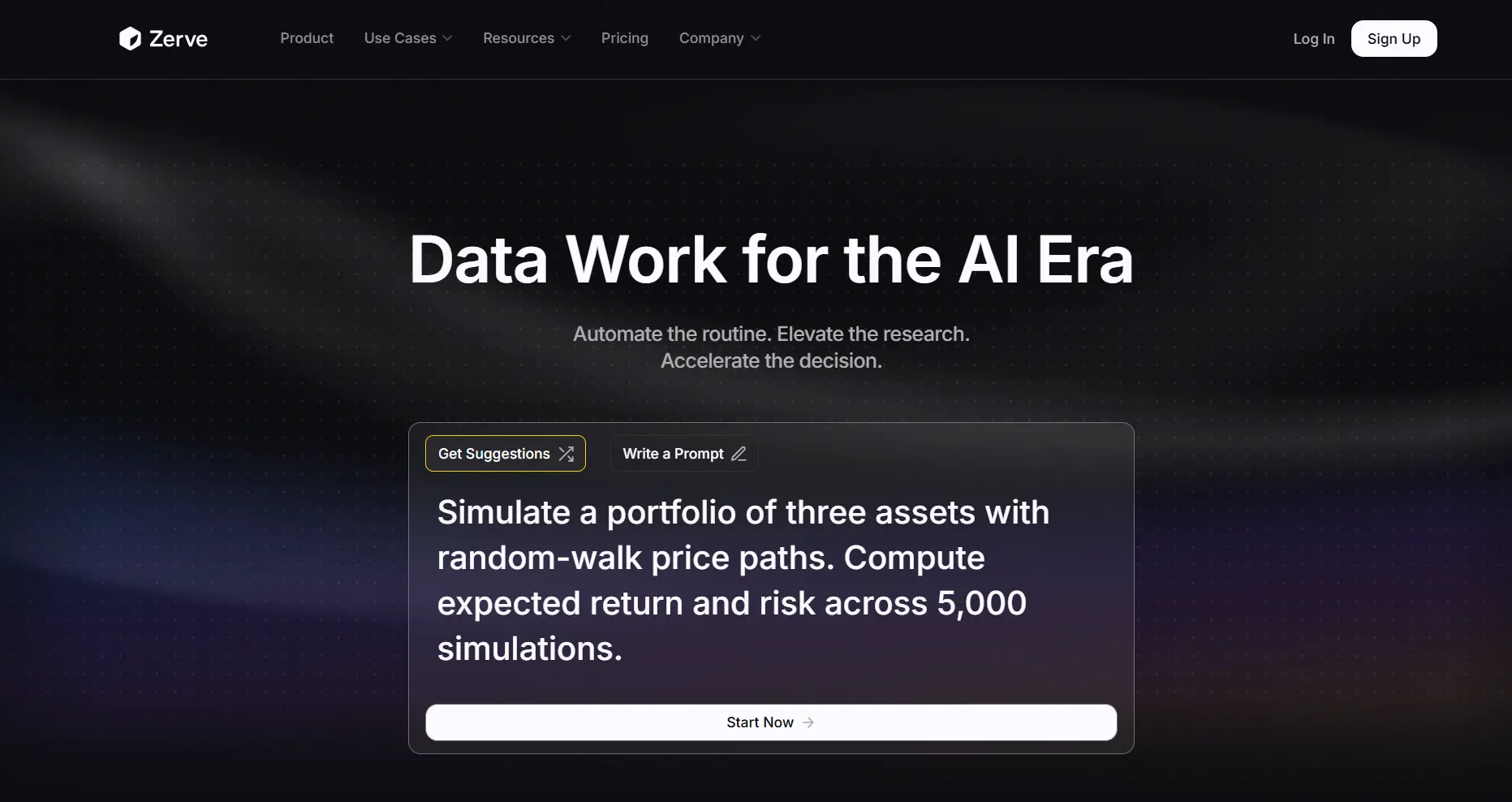
Many data teams struggle with fragmented tools and complex workflows.
Zerve AI addresses this challenge with an Agentic Data Workspace designed for modern data teams.
The platform provides:
Agentic Data Preparation
AI agents help automate data pipelines and feature engineering tasks.
Reproducible Workflows
Every experiment, dataset, and model run is tracked and versioned.
Seamless Deployment
Models can be deployed quickly as APIs or integrated into applications.
Built-in Monitoring
Automated monitoring detects performance changes and triggers retraining when needed.
Collaborative Environment
Teams can work together in a shared workspace, improving data collaboration and reproducibility.
Conclusion
By using historical data and machine learning models, companies can forecast future outcomes and act earlier.
However, building reliable predictive systems requires:
high-quality data
strong validation practices
continuous monitoring
Modern platforms like Zerve AI help simplify this process by providing tools for data preparation, model development, deployment, and monitoring in a single environment.
As predictive analytics continues to evolve, it will become an essential capability for every data-driven organization.
Frequently Asked Questions
Predictive analytics is the broader practice of using data to predict future outcomes. Machine learning is a set of algorithms used within predictive analytics to build predictive models. In simple terms, machine learning predictive models are one of the main tools used in predictive analytics.
The accuracy of predictive analytics models depends on several factors, including data quality, feature engineering, model selection, and validation techniques. While no predictive model is 100% accurate, well-designed predictive analytics systems can generate forecasts that are significantly more reliable than manual estimates.
The best predictive analytics tools depend on your team’s requirements, technical expertise, and infrastructure. Most data teams look for platforms that support data preparation, model development, experiment tracking, and deployment. Modern platforms such as Zerve AI provide an integrated environment for building and deploying predictive analytics workflows.
The time required to build a predictive analytics model can range from a few weeks to several months. It depends on factors such as data availability, project complexity, and team expertise. Platforms that automate data preparation and model deployment can significantly reduce development time.
Predictive analytics focuses on forecasting what is likely to happen in the future based on historical data. Prescriptive analytics goes one step further by recommending specific actions that should be taken to achieve the best possible outcome.